


Bullard at a Glance
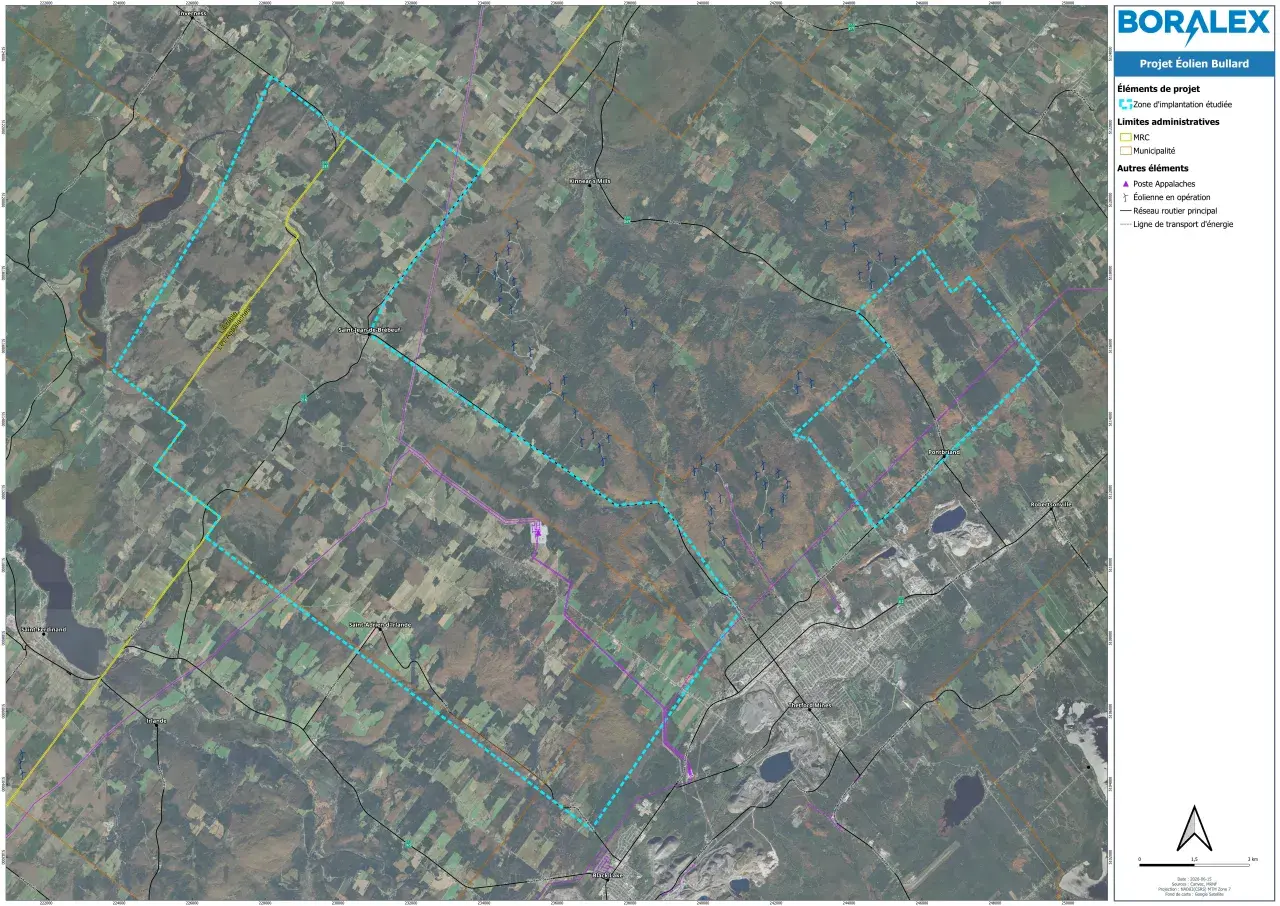
The Bullard wind project, located in the L’Érable and Appalaches RCMs, is currently in the site potential assessment phase. This process aims to determine whether the project could participate in Hydro-Québec’s call for tenders launched in April 2026 (AO2026-01). The area under study includes the municipalities of Saint-Jean-de-Brébeuf, Saint-Adrien-d’Irlande, and Inverness, as well as the city of Thetford Mines. If the project moves forward, Boralex aim for a potential commissioning date in 2033.
The Project Area
Stay Informed
Please be advised that these forms are in french only, and the content shared will also be in french only.
Community Involvement and Participation
Boralex prioritizes a community-based development approach rooted in dialogue, active listening, and collaboration with local stakeholders. From the very earliest stages of a project, we work in consultation with local partners to take into account the realities, concerns, and aspirations of the community as part of the project’s continuous improvement process.
With this in mind, discussions are underway with the Connectif des sommets and the W8banaki Nation. These efforts aim to foster the development of a project that integrates harmoniously into its environment and reflects the values and priorities of the affected communities.
Donations and Sponsorships
Boralex wishes to make a positive contribution to the vitality of the communities that host its projects. With this in mind, the company supports, whenever possible, local initiatives that promote social, community, environmental, cultural, or athletic development in the regions concerned.
Requests for donations and sponsorships are evaluated according to established criteria to ensure fair and consistent processing. Projects receiving support must demonstrate positive benefits for the community and align with Boralex’s values.
Organizations interested in submitting a request are invited to do so via the following link: Boralex
Frequently Asked Questions
-
At a time when energy and environmental concerns are at the top of the agenda, wind energy offers a solution to our growing energy needs while ensuring the utmost respect for the environment. Generated by the force of the wind, wind energy is a renewable and sustainable source of power. The production of this energy generates no waste or atmospheric emissions.
In addition to improving air quality, wind energy in Quebec offers several other benefits:
- It is currently the least expensive renewable electricity generation technology;
- It complements Hydro-Québec’s large hydroelectric dams. Wind power generates more electricity in the winter and therefore has the potential to help Hydro-Québec meet peak winter demand;
- Wind resources are excellent and abundant in Quebec;
- It produces no greenhouse gas emissions or toxic waste;
- It is an economic driver that fosters local and regional development and job creation;
- Installation and operating costs are competitive and stable;
- This technology requires no fuel.
-
We are currently in the process of assessing the project’s potential in preparation for Hydro-Québec’s 2026 call for proposals. Several factors still need to be analyzed, including the site’s wind energy potential, the project’s social acceptability, and various technical and environmental constraints, such as wetlands and water bodies, as well as regulatory requirements.
-
Several factors are taken into account when determining where wind turbines would be located. These include:
- Agreements and requests from landowners and farmers;
- Agricultural areas and maple syrup production potential;
- Wind speed;
- Wetlands and water bodies;
- Protected flora and fauna species and protected areas;
- Applicable regulations (minimum distances from waterways, residential areas, etc.);
- Technical conditions (buildability and soil stability);
- The results of public consultations. -
Information and consultation activities will be conducted throughout the project’s development. We will maintain an ongoing dialogue with the public and local stakeholders through meetings, information and consultation sessions, communication tools (e.g., newsletters), and regular updates on the project’s progress.
-
The project could generate economic benefits for the region through job creation, the hiring of local suppliers, and the payment of royalties to municipalities. As a general guideline, a 100-MW wind project can create up to 200 jobs during construction and 6 to 10 permanent jobs during the operational phase. Host municipalities would also receive annual royalties, set by Hydro-Québec, to which other benefits could be added if they participate in the project as partners.